
Byrne and Clarke, The University Challenge

Ed Byrne and Charles Clarke, The University Challenge: Changing universities in a changing world (Harlow: Pearson, 2020)

Written by the Ed Bryne, President and Principal of King’s College London, and Charles Clarke, former secretary of state for education and skills in the Labour Government, this book offers an interesting and timely(ish) take on the many challenges facing British universities.  I say timely(ish) since the Coronavirus pandemic has obviously caused sweeping changes to both society and to education, which will mean that universities will almost never be quite the same again.  It is interesting to reflect that this book is among the last books on universities written during the ‘old normal’.  A case could therefore be made that the book is out of date barely a month or two after it was published.  But I wouldn’t be so quick to dismiss its insights.  Many of the underlying theme will likely remain much the same (e.g. ‘Who benefits from a university education?’ – students and society), and the Coronavirus crisis will likely accelerate some of the trends discussed in the book (e.g. online learning and digital technology).  Our current situation also highlights the reliance of many British universities on international students, which may or may not be repeated as the crisis passes. 

The book is written from a middle of the road, pragmatic perspective, as might be expected when one of the co-authors was a minister in the New Labour government.  It is not against the idea that students should pay for their education, although it does make suggestions about how this could be done a little more fairly (although most of the proposals in that area seem more designed to bring financial stability and independence to universities).  It is focused on universities in the United Kingdom, but does have an international perspective, since Ed Byrne was VC at Monash University.  These international comparisons are interesting and help to put UK higher education into a wider context.  For example, with more universities teaching in English throughout the world, the advantage gained by universities in English speaking countries is likely to be lessened; China is going to have a number of top-10 universities in the next 10 years. 

There is some discussion of Widening Participation, which is one of the main reasons why I read the book.  Here the role of the Office for Students and the importance of Access and Participation plans is made very clear in a way that I’d understood before, but hadn’t fully appreciated.  For example, the University of Bristol is committed to spending 24.9% of its ‘Higher Fee Income’ (HFI) – which is estimated to be between £51m and £53m – on access and participation up to 2024-25.  This is divided between Access Investment 5.9% (about £3m per year), Financial Support, 18.5%, and Research and Evaluation 0.5%.  If this isn’t done, the OfS would stop the university from charging higher fees.

One other important thing I got from the book was the importance of the field of history for at least three of the four ‘key contributions’ of universities to addressing global change, which are discussed throughout the book:

  • Understanding and interpreting the process of change.
  • Offering approaches that would harness the process of change for general benefit. 
  • Educating and training to high quality the specialist workers whose skills are necessary to address change properly.
  • Creating a general intellectually engaging climate and culture across societies that promotes the virtues of understanding and science. 

Given the value of a historical training (or ‘change science’) I came away feeling that we’re significantly undervaluing what we can offer to the university.  The important of ‘problem-focused’ interdisciplinary research was also highlighted, especially towards the end of the book.  This is something I could do more of with my work, and with ‘Critical Physical Geography.’ 
David Hoyle, The Pattern of our Calling

David Hoyle, The Pattern of our Calling: Ministry Yesterday, Today and Tomorrow (London: SCM Press, 2016)

This is the first book on ministry that I read before my Bishops’ Advisory Panel that I’ve come back to and re-read afterwards.  As with the Cottrell book on priesthood that a read a couple of weeks ago, it’s an interesting to note the differences in reading about ministry knowing that I’ll be starting my formal training in the next few months than it was before I went to the selection panel.  This is a book that I read with interest a couple of years ago, and I remember sitting in the gardens of Temple Church reading a chapter or two.  But I came away from the first reading strangely indifferent about this book. It starts well and I’m sympathetic to the deep, spiritual vision of priesthood that Hoyle is trying to achieve.  But it fades somewhat, and the whole is a little less than the sum of its parts.  Despite really wanting to like this book, my impression after reading it a second time was very similar. 

It’s difficult to identify exactly why this book doesn’t quite work for me.  Hoyle is a historian, and he draws on historical examples throughout.  All of the priests and theologians discussed in the book have written something on the meaning of ministry, but other than that they’re an incredibly diverse group.  There is a lot of chronological jumping around, which sometimes makes the context difficult to follow.  Just when you’re starting to appreciate the fourth century world of Ambrose, Bishop of Milan, for example, we’re catapulted 300 years forward to the papacy/episcopate of Gregory the Great, who was made Bishop of Rome in 590, and then we immediately find ourselves in the presence of Bishop J.B. Lightfoot in late nineteenth century Durham.  All three are calling for moderation, and the meaning of moderation is different in each context.  That is the point that Hoyle is making, but it raises the question that if ‘Keeping Your Balance’ means something different in each example does it have universal value as a concept.  Some chapters take examples in reverse chronological order: Chapter 3, for example, gives us Wesley Carr, a DDO in Chelmsford in the late 1970s and early 1980s and then jumps back to Bishop John Fisher in Tudor England.  The challenge with introducing such a diverse range of historical characters (perhaps inevitably almost all men) is that the book ends up assuming knowledge about who they were and the context they worked in, and this gives it something of an exclusive, academic character. 

If the book has a central argument, it is an argument against the contemporary focus of the church on growth and leadership summed up in the word ‘managerialism’.  Growth and leadership, of course, are important, but they are only one aspect of priesthood.  The various examples we’re presented with through the book do come together to give a much more rounded vision of priesthood.  But the patterns of this calling are not entirely obvious.  For a book that calls on several occasions for a more united and more communal vision of priesthood, a case could be made that the underlying patterns need to be set out a little more clearly. 

Kathryn Yusoff, A Billion Black Anthropocenes or None

Kathryn Yusoff, A Billion Black Anthropocenes of None (University of Minnesota Press: Minneapolis, 2018)

Although it’s probably not the interpretation that Kathryn Yusoff was expecting, A Billion Black Anthropocenes or None might be read as critical physical geography on a meta scale.  The central argument seems to be that the Anthropocene is inextricably linked to deep structural racism and imperialism, most centrally to the history of trans-Atlantic slavery.  The geology that gives us the Anthropocene is a White Geology that seeks to construct a geologic permanence out of racial inequality.  Our current approach to the Anthropocene avoids confronting the fundamental issues of deep structural racism, and consequently offers little hope for getting through the coming storm (‘the diagnostic of the Anthropocene does not unleash any ethical crisis in liberal discourse about who is targeted by these material practices’ 902/1943).  The Anthropocene looks to the future rather than to the past to avoid needing to feel a sense of guilt.

Yusoff’s writing style reminds me more of the environmental humanities than most of the geography I’ve read and is sometimes deliberately difficult to follow.  ‘Drawing attention to a billion Black Anthropocenes, Yusoff writes, ‘is not a vehicle of visibility to see the dark underbelly of modernity with greater clarity, because it is already erased and caught in the process of erasure.’ I interpret this as meaning that there are no easy solutions, since the system itself is constructed to hide its true self (but I might be wrong).  There is, however, a sense that a more positive way forward may be found by ‘forging a new language of geology… that attends to the racialization of matter’ (1632/1943).  Poetry, poetics, and Denise Ferreira da Silva’s ‘poethics’ offer ways forward.  The book also highlights the importance of Sylvia Wynter’s 900-page unpublished “Black Metamorphosis” in understanding where we are and moving forward (which Yusoff went to New York to read). 

This could be a very helpful book for thinking about the history of the McMurdo Dry Valleys, and it is interesting to note that Yusoff’s early work focused on Antarctica (the idea that American genocide shows up in Antarctic ice-cores is fascinating).  The idea of ‘White Geology’ and the politics of extraction might be particularly useful for thinking about the construction of the McMurdo Dry Valleys as an imperial landscape.  The two reviews I read raised some interesting criticisms (e.g. ‘Yusoff does not decenter Eurocentric logics as much as she thinks she does’ in McKenzie Wark’s reivew).  But this strikes me as an important book and well worth reading again.

Kate Litchfield, Tend My Flock

Kate Litchfield, Tend My Flock: Sustaining Good Pastoral Care (Norwich: Canterbury Press, 2006)

This is a practical rather than theoretical guide to sustaining good pastoral care as a priest in the Church of England.  It comes across as a little dated, and I imagine some parts of the book – especially those related to disclosure and confession – may have changed since it was originally published in 2006 [second printing 2011].  The approach to themes such as homosexuality and gender give the impression that they were modern and innovative fifteen years ago, but come across as slightly old-fashioned today.  This is a lesson in how quickly attitudes change, perhaps especially in the field of pastoral care.  But the book is full of helpful advice, some of which might be seen as timeless.  It is unlikely, for example, that the need for ministers to take time off, is going to change any time soon; funerals are going to be emotionally draining and bring up personal issues for the officiant whenever they take place.  Perhaps it says something about the approach of the Church to pastoral care that a book such as this looking at the ‘unspoken’ aspects of ministry was so new, so recently. 

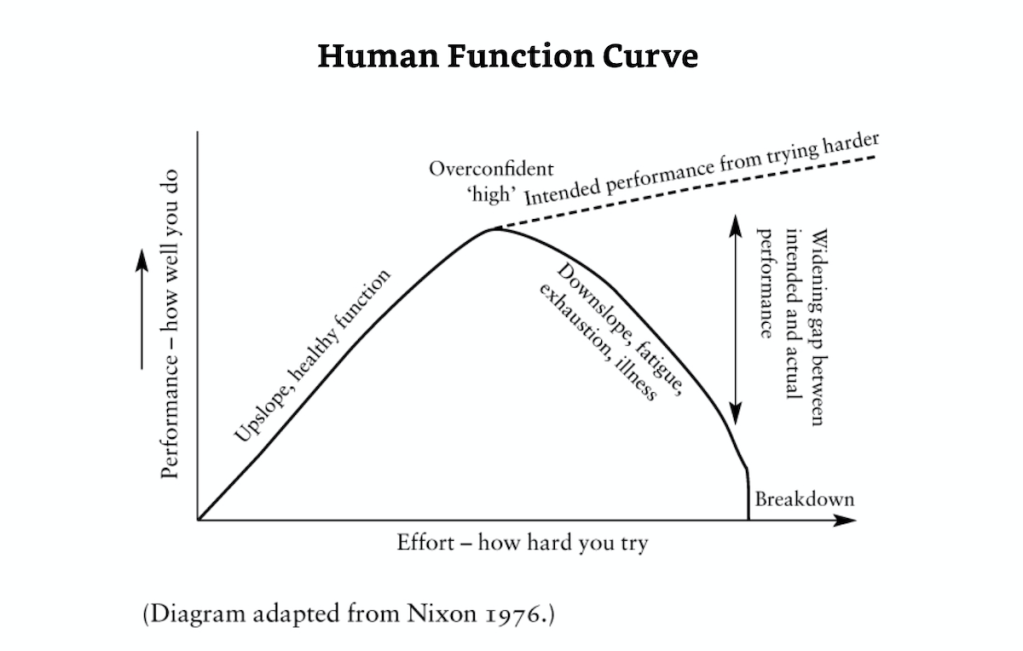
While nothing in the book jumped out at me as a huge surprise, it was very helpful in presenting the major issues that arise around pastoral care.  It may be easy to overlook, for example, some of the power dynamics involved in ‘tending the flock.’  There is a sense in the book that ministry is becoming more dispersed among the members of the congregation, and perhaps more could be done to explore some of the less clearly-defined power dynamics that this exposes.  I like the section on ‘The Human Function Curve’ developed by Peter Nixon in 1976, which links effort and performance up to a certain point, but then past this point it drops off and it becomes more effective to try to work less hard:

A close up of a map

Description automatically generated

The main audience for the book is the full-time stipendiary minister, but at least some attention is paid to self-supporting ministry (although this isn’t explored in the detail that it perhaps would be today).  There are going to be some intense experiences ahead as I train for self-supporting ministry, but I get the sense that reading this book will be good preparation for what lies ahead. 

Stephen Cottrell, On Priesthood

Stephen Cottrell, On Priesthood: Servants, Shepherds, Messengers, Sentinels and Stewards (London: Hodder and Stoughton, 2020)

This book by the new Archbishop of York is in some ways a fairly standard view of priesthood in the Church of England.  It begins, as many of the priesthood books I’ve read do, with the claim that most books on the priesthood ask for priests to be doing much.  And then, as with most of these books, it goes on to ask a lot from priests.  Specifically, it takes the words from the Church of England Ordinal to suggest that priests should be servants, shepherds, messengers, sentinels and stewards. It finishes, again as is traditional in the genre, with a couple of chapters on the pain of priesthood (‘carrying the cross’) and finding a balance (‘guarding the heart’).  I’m tempted to write that by the end of the book I was exhausted just thinking about everything I’ll have to do as a priest, but perhaps that’s a little unfair. 

Despite not deviating much from the standard approach of books in this genre (even in the early statement that the book was largely put together from addresses given to ordinands on the eve of their ordination, which seems to be the usual way these books get written), this is a useful book.  In particular, I found its approach to self-supporting ministry very refreshing.  It treats self-supporting ministers as equals to stipendiary ministers, and suggests that a priest is who you are not what you do.  There is no such thing as a part time priest (and as a consequence no real day off, which perhaps adds to the exhaustion).  The discussion of the language of priesthood was also very helpful.  Priests need to speak the language of the communities they serve, and a one-size-fits all approach is rarely appropriate.  It is a very nicely written book, and there are some wonderful phrases and images.  For example: ‘Leading like Jesus means expanding our capacity for compassion, empathy, concern for justice, and love. We do this by emptying ourselves of all that is not of God – our self-referential and self-preoccupied ways of inhabiting the world and the ways we screen ourselves from God’ (1900/2343).  I also appreciated the discussion that ordained ministry ‘must be built on two priorities more than any other − time for yourself and time for God.’ (1772/2343)

The introduction contains an interesting discussion of creation care, as one of the five marks of mission.  The chapter on stewardship could have perhaps done a little more to follow up on some of these ideas – it’s more about general management (in a good way) than specifically environmental connotations of this term.  But the book does contain a great quote from Pope Francis that he wanted priests ‘with the smell of the sheep’ (634/2343).  But in a book that is already full of things for priests to be doing, perhaps it’s good that a discussion of environmentalism doesn’t take over.   

Eddie Jones, My Life and Rugby: The Autobiography (London: Macmillan, 2019)

The autobiography of the England rugby team’s head coach may not be the obvious place to look for lessons in Christian leadership.  But there is much to learn about leadership from this book, and much of this could be applied to thinking about training for self-supporting ministry and seeking to shape the future of the Church. 

Born to a Japanese mother and an Australian father, Eddie Jones grew up in one of the poorer suburbs of Sydney.  He grew up playing rugby union at Matraville Sports High School with the Ella brothers, Gary, Glen, and Mark and fell in love with the sport.  He played hooker for Randwick, one of the most successful Sydney clubs, but never made it into the Australian rugby team, perhaps the biggest disappointment of his early life.  Alongside his playing career he worked as a teacher, and quickly took on leadership roles.  Shortly after giving up played he faced a choice between continuing to work in education or taking the much riskier option of trying to become a full time coach.  He chose to take a risk and went on to become one of the most influential and successful coaches of his generation. 

One of the most striking things about Eddie Jones’ coaching career is its international scope.  He’d coached in Australia, Japan, South Africa and England, and enjoyed great success in all four countries.  There’s a clear sense in the book that context matters, but at the same time there’s a sense that the fundamentals of being a good rugby coach transcend cultural difference.  In fact, one of the lessons for being a good coach might be an understanding that context matters.  Beating South Africa with Japan in 2015 was a very different challenge than trying to win the World Cup with England in 2019, but he was able to draw lessons from one experience that applies to the other.  Interesting Jones comments on similarities between British and Japanese societies and suggests that the English, in particular, are even more attracted to strong leadership. 

After suffering a relatively mild stroke while working in Japan, Eddie Jones started going to Church.  ‘I have never been a practising Christian,’ he writes, ‘but I found peace in church.  It was not some dramatic conversation – but, rather, a place where I could reflect and give thanks for my returning health, my family, and my work.  I began to strongly believe that there is a purpose for all of us in our lives’ (247).  It is the sense of purpose and commitment, more than any overt statements about belief or faith that for me resonated most with a vocation to Christian leadership.  Every day, it seems, Eddie Jones wakes up and asks ‘how can I be a better rugby coach?’  This is not necessarily the way I’ve been thinking about a vocation to self-supporting ministry, but perhaps it should be.  ‘How can I be a better Church leader?’  Asking that at the start of each day may help me seek out experiences, conversations, and opportunities to reflect that will keep me improving.  It’s not an easy approach to life, and Eddie Jones has frequently found himself needing to pick himself up and dust himself off following a bad loss.  His motto is don’t listen too much to the praise during the good times or the criticism during the bad times.  But do keep learning and trying to improve. 

At the end of the book, Jones writes that ‘the art of good coaching is turning an idea in your head into reality on the field’ (421).  This fits nicely with the classic definition that leadership is having vision and making it happen.  What are some of the lessons in leadership from the book?  Don’t get comfortable.  Always think you can improve.  Context matters – coaching in Japan is not the same as coaching in South Africa.  Make strong connections with the influential personalities in a group. Don’t give up.  Get knocked down but keep getting up again.

Haruki Murakami, Dance, Dance, Dance (London: Vintage, 2003 [1988]). Translated Alfred Birnbaum

This time last year, Haruki Murakami’s Wild Sheep Chase (first published in Japanese in 1982) helped to guide me around Japan during my research trip to the National Institute of Polar Research.  The sheep-man related shadowy industrialist right wing politician figure with connections to the Japanese empire before the Second World War provided me with a model for trying to make sense of Tetsuya Torii, the rich geochemist who led Japanese research in the McMurdo Dry Valleys from the 1960s to the mid 1980s.  Of course such a comparison is deeply unfair, and betrays my shallow understanding of Japanese culture.  But there was just enough in common for this comparison to make sense to me, and there seemed something Murakami-esque blurring of fantasy and reality about our ‘wild sheep chase’ in search of information about Japanese polar research.  With a little imagination, I could make a comparison between the NIPR library in the outskirts of Tokyo and the musty library on all things sheep related hidden in the depths of Sapporo’s Dolphin Hotel.  And I even travelled to Hokkaido by bullet train on my own Wild Sheep Chase pilgrimage. 

Dance, Dance, Dance is the sequel to Wild Sheep Chase.  The sheep-man is still here, hidden on the sixteenth floor of the newly renovated Dolphin hotel.  But he seems to have lost his showy right-wing industrialist connections, and is now someone different (I’d need to go back to the ending of Wild Sheep Chase to really think through this identity).  There are many similarities between the books and many of the same characters.  The 34-year old protagonist is the same person.  But the sinister conspiratorial pulling of strings at a national level from the first book is replaced by more of a simple murder mystery.  The ‘high class prostitutes’ that the protagonist manages to sleep with almost purely by chance have a habit of disappearing, and in one case is brutally murdered.  The main character is brought into the police station for an extended interrogation about her death, but manages to keep silent in defence of his movie-actor friend (who in this case had provided the prostitute).  The unlikely relationship between the 34-year old protagonist and a 13-year old girl with special powers of foresight, who he meets in the Dolphin Hotel is central to the story, although it’s a little unclear why.  There are, as always with Murakami, lots of seemingly disconnected themes and unresolved plots.  But despite a lack of neatness and clear resolution, everything comes together and it another tremendously gripping Murakami novel. 

Jonathan Herbert, Accompaniment, Community and Nature: Overcoming Isolation, Marginalisation and Alienation Through Meaningful Connection (London and Philadelphia: Jessica Kingsley Publishers, 2020)

What is meaningful connection?  This is a question we’re likely to be asking ourselves with more urgency during a time of Coronavirus lockdown and deliberate social isolation.  In this honest, yet tremendously hopeful book, Jonathan Hebert presents a series of episodes from his life as a priest, and his experiences of living in various intentional communities around the world, particularly the Pilsdon Community and Hilfield Friary, both in rural Dorset in South West England.  He sets out the idea of accompaniment as a sense of working, walking, and waiting alongside another person.  Accompaniment, he suggests, is ‘less than friendship and also much more.’  It’s about living well with people who are different from us and building interdependence.  Perhaps above all, accompaniment simply involves spending time with people, and being together.  For all its apparent simplicity, in a world of constant busyness, where ‘time is money’ and even our leisure activities are measured by how much we’re doing, the idea of accompaniment is deeply counter-cultural and not at all easy. 

Meaningful connection can happen in surprising ways.  I ‘met’ Jonathan Herbert during a zoom call when a retreat we were planning from Bristol to Hilfield Friary was cancelled as a result of the Coronavirus crisis.  In just a few minutes of conversation he spoke passionately about life at Hilfield Friary and his experiences of community, and he gave us encouragement to keep moving forward with our plans for a City Farm Church in Bristol.  He mentioned his recently published book, and I was immediately inspired to read it.  Even from within the four walls of my social isolation, the book gave me a deep sense of connection with Herbert and the communities he has lived in.    

The book is beautifully written.  Rather than presenting the experiences from his life in chronological order, Herbert adopts a thematic approach, picking appropriate episodes to illustrate his points.  In the first chapter, he sets out alienation and loneliness among the central crises of our age:

My journey through this book is about first seeing the danger and threats we face, the crisis of loneliness and alienation we are living in, acknowledging the damage that has been done by the destructive forces of individualistic thinking, and then journeying towards a more holistic understanding of what it means to live well together (Kindle loc 154). 

Chapters on community, accompaniment, sharing labour, crossing divides, making peace, living sustainably, and knowing ourselves, offer powerful ways to confront alienation and loneliness.  Not all of the stories are uplifting.  Herbert writes compassionately about destructive addictions, violent confrontations, institutionalised racism, and child kidnappings.  But the picture that emerges, over and over again throughout the book, is that a different, less individualised way of living is possible.  This possibility brings hope even to the darkest places.  I was particularly drawn to stories of getting to know people by walking and working together: fixing a roof with a convicted criminal, being together as horses were put down, walking together in pilgrimage.  

I’m a little wary of the concept of ‘nature deficit disorder’, which Herbert turns to occasionally to explain the value of spending time at a place like the Pilsdon Community of the Hilfield Friary.  It’s not that I disagree with the healing and restorative powers of being outside surrounded by what we would traditionally recognize as ‘nature’ – fields, trees, wildlife, farm animals.  On plenty of occasions I’ve felt a strong need to get out of a seemingly oppressive city and into the spacious liberation of the countryside.  But this urge has worked the other way as well with the craving for the bright lights of a city.  I worry slightly that ‘nature deficit disorder’ perpetuates a binary of the natural and the unnatural, and risks imposing one particular set of cultural values onto people from other cultural contexts.  A deficit model, by its nature, views something – and perhaps by extension, someone – as lacking.  In my view, Herbert’s central theme of meaningful connection with difference can explain the value of living in an intentional rural community in a much more positive way.  As demonstrated throughout the book, we can all benefit from connecting with different people and unfamiliar, and from the self-reflection that these encounters can bring. 

The book finishes with two short appendices on ‘hints for accompaniment’ and ‘essential ingredients for living in community.’  Vision, for example, is all-important for successful community life, since without it, things will break down as soon as difficulties start.  Accompaniment, Community and Nature is a ‘how to’ book in the very best sense.  There is plenty of idealism, but this is accompanied by constructive and practical action.  The action promoted by Herbert is the exact opposite of the constant, unreflective activity that pervades our individualistic world.  Doing less can very often be the key to doing more.  The book will be of interest to anyone who has lived in community, or anyone who is contemplating living in community.  But more broadly than that, this is truly inspirational book that should be read by anyone looking for practical ways to bring meaningful change to a broken world. 

Mark Carrigan, Social Media for Academics. Second Edition (SAGE, 2020)

Towards the end of my time in Colorado, I read the first edition of Mark Carrigan’s Social Media for Academics.  I remember taking the bus into Denver Public Library, reading the book and planning how I might make better use of social media in my work.  I think I already had accounts on twitter and facebook, but I wasn’t making much use of these.  And, being honest, I wasn’t really drawn to social media at all.  For me, reading the first edition of the book and planning to ‘do more’ was a very typical response of starting something new and unfamiliar: first read a book about it, and then do it.  For a short time I was motivated to do more with social media.  I started several blogs, I tried to force myself to send a couple of tweets each week, and, probably at the same time as many of my friends and colleagues were trying to spend less time on twitter and facebook, I was resolving to spend more time on social media. 

Despite enjoying the first edition of the book and being inspired by it to do more, I quickly reverted to sustained social media inactivity.  At heart I’m a shy and private person and I’ve been perfectly happy living largely offline.  I don’t like conflict, and I’ve never really felt the urge to ‘share’ the things I’ve been doing.  Reflecting on this, especially given the language of sharing, there is perhaps an element of selfishness to this, and almost certainly a false humility.  Whenever I have ventured onto social media, I’ve generally struggled to see the point.  Catching up with old friends is been a treat to enjoy occasionally over a beer or two, not an everyday activity.  Indifference has jostled with outright scepticism: I still have the idea that social media makes people angry, creates divisions, and trivializes grief.  Perhaps most significantly, I’ve managed to be relatively successful in my work without needing to use social media.  It may well be that I’m part of the last generation of academics that can say that. 

The Coronavirus pandemic is changing everything.  Stuck working from home, the whole of my professional life seems to have gone online, as does much of my personal life.  It seems like there is little choice but to embrace these online communities and the technologies that facilitate them.  All our classes, for example, are going online.  But where do I start?  Luckily some things never change. My response to a new challenge is, as always, to look for a book and read about it first.  So I was delighted to find that a second edition of Mark Carrigan’s Social Media for Academics has recently been published.  I read a hard copy of the first edition; it seems to be some sort of progress that I ordered the Kindle version of the second edition and read it on my iPad. 

While I remember the first edition as being focused more on the technologies themselves and the practicalities of using them, the second edition seems to take more of a theoretical approach (this could just be that my focus last time was more on the practice than the theory, since everything was so new).  The second edition opens by saying that if you’re going to use social media effectively (and critically) you need to ask three questions: why do you want to use social media? What do you want to do with it? How will you do this?  Working from home has given me the time to write out answers to these questions as I read the book.  This proved extremely helpful.  Rather than focusing primarily on the how, most of my focus as I read the book was on the why.  Why am I wanting to use social media and what am I hoping to achieve by using it? 

There is a chapter in the middle of the book on identity and social media, which I found especially useful.  If I’m being honest, one of the things that has stood in the way of embracing social media has been the question of identity.  Who am I and which parts of my identity do I want to ‘put out there’ on social media?  While my identity as an academic is quite strong, other parts are less so.  In particular, last time I read the book I was just beginning to explore the possibility of some form of ordained ministry in the Anglican Church; this time I have been accepted for training for self-supporting ministry by the Church of England.  One of my motivations for wanting to use social media is to explore what it means to be a Christian environmental historian.  While I’m excited by this, I’m also a little wary and I appreciated that Carrigan’s book repeatedly addresses the challenges and potential pitfalls of using social media.  It’s important for me to accept that some people might see my religious vocation as undermining my academic reputation. 

My plan moving forward is to spend the next three months trying to do more with social media.  I hope to maintain two blogs offline: this one, for work and religion related posts, and ‘Food, Culture, Travel’ for everything else.  I also intend to spend more time on Twitter and Facebook, and perhaps also on LinkedIn and Academia.edu.  In late June, or early July I plan to read through this second edition of Social Media for Academics and ‘go live’ with my two blogs.  This may also be a good time for an audit of my online identity. 

Introduction

As an environmental historian at the University of Bristol and a candidate for self-supporting ministry in the Church of England, my work encompasses religion, environment, and history.  Most of my academic research focuses on the environmental history of the Polar Regions, and I am a co-PI on the McMurdo Dry Valleys Long Term Ecological Research project in Antarctica.  My main religious affiliation is with St Stephen’s Church in Bristol city centre, where I help to run the Resonate community; I am also an associate member of the Iona Community in Scotland.  I am especially interested in the practical ways that environmental history and environmental theology can be used promote social justice and sustainability in contexts ranging from human impacts in Antarctica to urban agriculture in Bristol.  This blog will be a place where I can explore and share these ideas.  All of the opinions expressed are my own and do not necessarily represent any of the institutions I am affiliated with.