
What does it mean to be a Christian environmental historian? 

I was ordained as a priest at Bristol Cathedral on 29 June this year.  Since my ordination, I’ve been thinking more about what it means to be a ‘Christian Environmental Historian’ and to work as a self-supporting minister teaching environmental history at the University of Bristol.  Over the next few weeks, I hope to explore this question on this blog. 

Most fundamentally, being a Christian environmental historian means that I can draw on my academic work in my ministry and use my ministry work to inform and shape my work in environment history.  But what does this mean in practice?  What does it mean to draw on my academic work in my ministry?  What does it mean to use my ministry work to inform and shape my work in environmental history?  These are the questions I’m hoping to explore in some depth as I reflect on what it means to be a Christian environmental historian. 

Being a Christian environmental historian also positions me towards the edge of both academia and ministry.  As a self-supporting minister, I’m no longer a full time academic and neither am I a full-time minister.  This ‘peripherality’ or ‘edginess’ is something that I’m comfortable with, although it does come with certain challenges, especially related to use of time.  At the same time, this positioning also makes me something of an insider in two quite privileged roles, and I need to be careful not to overstate the ‘peripherality’ or ‘edginess’.

In short, being a Christian environmental historian is both something theoretical and something practical.  It shapes who I am, and it shapes what I do.  It’s also important to say that I didn’t suddenly become a Christian environmental historian at my ordination a couple of weeks ago.  As a lifelong Christian, it has been part of my identity since I first started to call myself an environmental historian over 20 years ago.  But there is something about becoming a deacon and a priest that have built this more fully into my professional identity as a much more public Christian. 

I’m excited to call myself a Christian environmental historian, and I’m excited to be exploring what this means.    
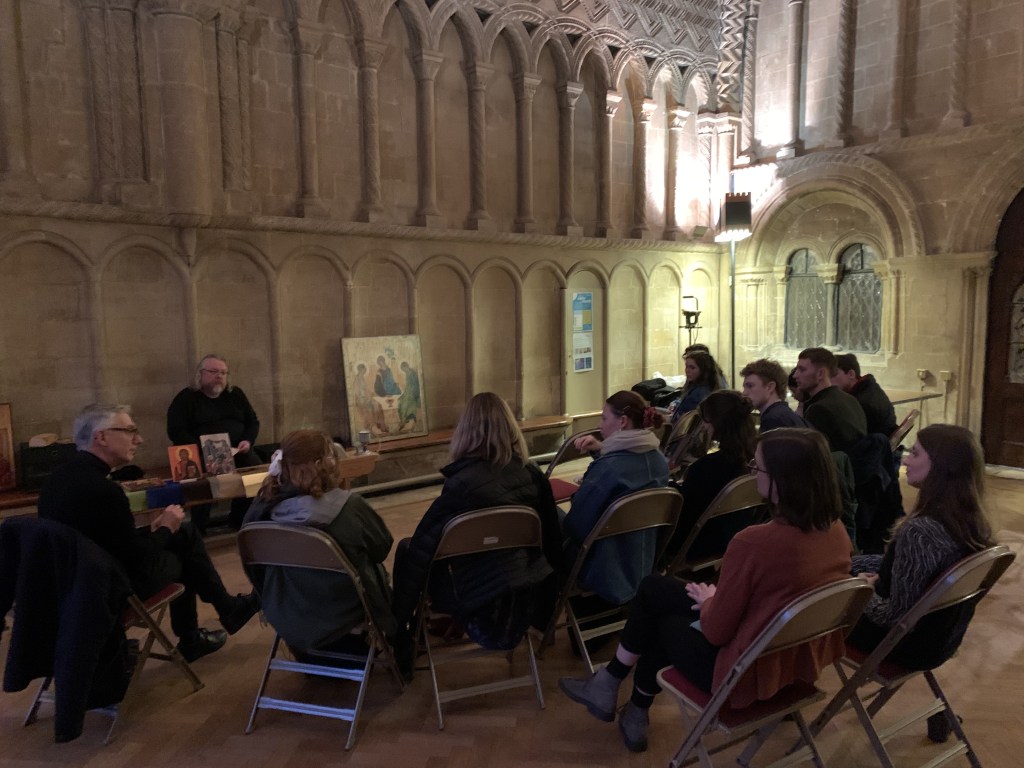
Theme in Environmental Humanities MA Class Visit to Bristol Cathedral

On Monday this week we went to Bristol Cathedral to learn about the Cathedral’s efforts to get to net zero carbon this week. Cannon Missioner Jonnie Parkin led thee session and focused on both the practical things the Cathedral is doing, and on the theological underpinnings of these efforts. A major focus was on on climate protest. We’ll discuss more at the next Themes in Environmental Humanities class. 

Flight Ways

Thom Van Dooren, Flight Ways: Life and Loss at the Edge of Extinction (Columbia University Press, 2014)

An important early work in the field of Environmental Humanities, Flight Ways focuses on the meaning of extinction in the current age.  It examines the plight of five species of birds: albatross, vultures, penguins, cranes, and crows on the edge of extinction.  The argument is that extinction is not a one-time event in which a species that once existed ceases to exist, but much more of an ongoing process.  Although perhaps not developed quite as fully as it could be, the concept of ‘flight ways’ is used to summarise the evolutionary history of a particular species and the myriad of intersections with other life on earth.  Van Dooren’s approach is sometimes quite theoretical, but mostly very readable and easy to follow.  This is a good introduction to the field of environmental humanities that asks some important questions about the relationship between humans and non-human animals over time.    

In the TLS this week…

Some interesting books in the TLS this week:

Netflix, The Chair.  [Reviewed by Patricia A. Matthew.  A tv drama set in a US English department and focused on tensions created by race and tenure decisions.  Stars Sandra Oh as the chair.]

Tristram Hunt, The Radical Potter: Josiah Wedgewood and the transformation of Britain [Reviewed by Keith Thomas.  Engaging biography of the eighteenth century industrialist and artist Josiah Wedgewood, who made a fortune and changed the artistic tastes of a country that was starting to drink a lot more tea and developing more sophisticated rituals surrounding its consumption.  The biography is written by Tristram Hunt, director of the Victoria and Albert Museum, who used to be MP for Stoke, which Wedgewood did much of his work.  Hunt had been involved in efforts to save the Wedgewood collection as an MP, and this biography would seem to be an outcome of that interest. 

Minouche Shafik, What we owe each other: a new  social contract; Ed Miliband GO BIG: How to fix our world; Ian Goldin: From global crisis to a better world.  [Reviewed by Ann Peteitfor.  Three books proposing ways to recover from the Covid-19 pandemic.  It sounds like Ed Milibands book is the most genuinely radical, and takes into account the challenge that global warming poses to the doctrine of constant growth, whereas the other two are more orthodox in their approach.  Minoche Shafik is director of the LSE, so probably no surprise she is an economic liberal.]

Holiness and Desire

Immediately before and after summer school at Sarum College last week I read two books by Jessica Martin (a minister in the Church of England) about human identity and ministry.  The first was Holiness and Desire about what makes us who we are.  There is a focus on issues of human sexuality, but the book is wide-ranging and engages with many different elements of what it means to be human.  In our hyper-sexualised contemporary world, Martin explores the blurring of reality with ‘virtual reality’, especially in issues related to pornography.  The book challenges several of the positions the Church of England is currently taking on human sexuality, and calls out a number of double standards, especially in its attitudes towards homosexuality.  These criticisms allow Martin to take a broadly traditional ‘one person one partner’ approach to sexual morality while being much more open-minded and humane than the current position of the Church.  It is a very well written and extremely moving book. 

The second book was For God’s Sake: Re-imagining Priesthood and Prayer in a Changing Church (co-edited with Sarah Coakley).  This comes out of discussions of the Littlewood Group of practicing theologians (mostly, it seems from the Anglo-Catholic wing of the Church of England).  It looks at a variety of Church offices, including baptism, marriage, and funerals, and well as priestly ministry more generally.  Jessica Martin’s chapter on daily prayer is particularly good.  This is a good book to come back to as a study and experience these different offices. 

Holiday Reading

Some books I read on holiday on Dartmoor last week:

Philip Sheldrake, Spaces for the Sacred: Place, Memory, and Identity (2001)

[While it often seems to be more about spirituality than place, and several opportunities are missed for making connections between the two, this is an interesting book that starts to explore the importance of place in theology.  As noted in the preface ‘The book is intended to be an exploration of ideas and interpretative perspectives rather than a systematic study of place or an attempt to produce a comprehensive thesis on the subject.  The final chapter on cities was a little frustrating, since I don’t think there is inherently less connection to place in urban environments than rural environments, although the relationship is in some ways quite different.].

Harold M. Abrams, Britain’s National Parks (1959)

Written by the 100m sprint winner at the 1924 Olympic games (and character in Chariots of Fire), who went on to be the Secretary of the National Parks Commission, this book brings together chapters on all ten of England and Wales’ national parks.  The collection has something of an official ‘celebratory’ view, but it is not without critical comment.  It offers a fascinating insight into ways of thinking about national parks in the late 1950s, as well as some very helpful insights into the administrative history. 

Matthew Kelly, Quartz and Feldspar.  Dartmoor: A British Landscape in Modern Times (2015)

It was fun to properly read this book while on holiday in Dartmoor.  In a sense this is three books in one, with the first part focused on C.18th and C.19th druidism, the second part on Dartmoor prison and the concept of improvement, and the third part on this history of Exmoor national park.  As noted by some of the reviews, I don’t think the three parts fit together perfectly, and perhaps more could have been done to develop the connecting themes.  But as individual studies each works very well.  I was particularly interested in the third part on the history of conservation on Dartmoor, which has lots of material on the national park, although that’s probably not the focus.  There have been lots of connections to Exmoor, and this part of the book is definitely worth coming back to. 

Miranda Threlfall-Holmes, How to Eat Bread: 21 Nourishing Ways to Read the Bible

I bought this book after Miradna Threlfall-Holmes was interviewed about it on the Church Times podcast.  It’s a really insightful overview of different ways to read and study the Bible and would make a really good book to recommend to anyone interested in going deeper in Biblical scholarship.  In many ways its quite an academic book, and it engages with many of the themes we explored in the Using the Bible Today module at Sarum last term.  A more wide-ranging bibliography for each chapter would be helpful for students wanting to use the book as a springboard to deeper study. 

Stephen Jones et. al, Behind the Lions: Playing Rugby for the British and Irish Lions (fourth edition, 2021)

This was a fun book which I finished after watching South Africa beat the Lions in the third test to win the series.  In general the Lions seem to have struggled, but there have been moments, especially in the 1970s, when the Lions team was truly outstanding (on tours to New Zealand and South Africa).  Much of the book consists of interviews with players from the respective tours, but there are also helpful overviews of each tour. 

Parish and Place

Andrew Rumsey, Parish: An Anglican Theology of Place (London: SCM Press, 2017)

This is a slightly strange book.  It has all the trappings of academic scholarship, including – at some points in the book – at least one direct quote from a philosopher or theorist in every paragraph.  Each chapter begins with a poetic meditation on some aspect of the parish, generally based more on personal experience than theory.  Beyond the broad argument that geography matters to theology, it is not immediately clear what the main arguments are, and there is perhaps a sense that this a book trying to do too much.  The concept of the parish certainly helps us to connect to place, and long-serving vicars are frequently wonderful guides to the geography of ‘their patch’.  One argument made by Rumsey is that Parishes have not been static, but have adapted and changed to survive.  This change is arguably happening more rapidly at the moment – with the joining of parishes and the creation of multi-parish benefices – than at any time since the creation of the parish system.  Despite the fact that Rumsey served as incumbent in the parish of Gipsy Hill in London, his discussion of urban parishes seems quite superficial.  What is the meaning of a parish in a city where liturgical and theological preference, more than geography often determines church attendance?  But despite its limitations this is a useful book, and it is worth reading for its references alone.  The parish does matter, and Rumsey is a helpful guide to thinking through the various challenges and opportunities.  It is a book that is certainly worth coming back to in thinking about the environmental history of the Church of England.   

TLS Interesting Books

Some interesting books/articles from the TLS this week:

Mark Synnott, The Third Pole: My Everest Climb to find the truth about Mallory and Irvine (Headline) [Reviewed by Jonathan Buckley.  The historical quest provides an excuse for climbing a mountain that he didn’t want to climb, providing insights into our contemporary attitudes towards mountains and nature.].

Gordon Campbell, Norse America: The Story of a Founding Myth (OUP) [Reviewed by Jane Kershaw.  An examination about what the myth of Norse discovery has meant for America, up to and including the recent storming of the capital].

Alice Oswald and Paul Keegan (editors), Gigantic Cinema: A Weather Anthology (Cape) [Reviewed by Nancy Campbell.  An engaging collection of writing on the weather from around the world].

Lisa Taddeo, Animal (Bloomsbury Circus) [Reviewed by Beejay Silcox.  An intense novel focused on the experiences of Joan, who is ‘trained in the art of sexual combat’, and describes herself as depraved.  Taddeo was recently interviewed on Front Row].

Jessica Kilburn, Thomas Hennell: The Land and the Mind (Pimpernel Press).  [Reviewed by Susan Owens.  A life of the largely forgotten English landscape painter Thomas Hennell, who worked largely in the early C.20th].

Glenn Frankel, Shooting Midnight Cowboy: Art, Sex, Lonliness, Liberation, and the Making of a Dark Classic (Farrar, Straus and Giroux) [Reviewed by Keith Hopper.  Sounds like a very interesting book that explores the making of the 1969 film Midnight Cowboy staring Jon Voight and Dustin Hoffman.  It was an important exploration of gay relationships and the only X-rated film to win best picture at the Oscars]. 

Kate Darling, The New Breed: How to Think about Robots (Allen Lane) [Reviewed by Regina Rini.  Sociologist of robotics arguing that we should treat robots like animals.  They are not going to take over the world just yet…. Regina Rini explores some of the problems with this and the power it gives to AI companies.].

Sustaining Church

We had the Hazelnut Community ‘Sustaining Church’ conference on Wednesday and Thursday this week.  The whole conference was incredibly inspiration, and left me with a sense that something very important is happening with environmental theology at the moment, and with our work at Hazelnut.  For me the standout presenters were Ellen Davis, Nurya Love Parish, and Norman Wirzba, but almost everything I saw was interesting and powerful.  In particular I was stuck by Norman Wirzba’s discussion of repentance and healing, and what this means for the Church and for me.  The environmental crisis is also a spiritual crisis, and a spiritual crisis requires some sort of spiritual response.  We don’t have all the answers, and in many cases we’re part of the problem, so we need to approach environmental theology in a state of humility and repentance.  The church that emerges through engaging with the environmental crisis will likely look very different to the church as we know it today.  I’m excited to be participating in this work. 

Thoughts on Religion, Colonialism, and Antarctica

I received some really helpful feedback on my ‘Colonialism without Religion’ paper at the Antarctica and Colonialism workshop earlier this week.  I’d like to thank everyone who participated in the conference, even though I don’t put names to comments here.  A lot of Dipesh Chakrabarty’s early work related to the relationship between the secular and the sacred, so it would be interesting to revisit this, especially in relation to his subsequent turn towards climate and history.  Within the South African Antarctic programme, religion can add another cause of difference with Black South Africans attending prayer meetings, and whites often being less keen.  There is an interesting question of definition: when does spirituality become religion?  What should I do with religion beyond Christianity?  Is religion capable of creating a common language in a similar way to science?  It’s really helpful to think about religion in relation to daily life in Antarctica.  Religion offers one of the structures needed to keep people going.  In the mid/late C.19th Matthew Fontaine Maury explicitly called on the nations of Christendom to explore the Antarctic, linking Antarctic exploration to the advance of nations.  Cross placed at Kerguelen in 1923 by French colonial inspector, despite France being a secular state.  How does religion frame the moral narratives of Antarctica?  Does the attempt to draw commonality with the Antarctic experience end up reinforcing a sense of difference?  Look at Ronit Y. Stahl’s Enlisting Faith: How the Military Chaplaincy Shaped Religion and State in Modern America  (Harvard 2017).  Does religion play a role in helping to justify the logic of humans over nature?  Important to mention the Papal Bull as a foundation for Argentine and Chilean claims.  Amundsen seems to have been a lot more secular than Scott, adding a religion dimension to the competition.  There is an interesting relationship between religion and the sublime.  Ask question about how religion drives actions in Antarctica.  E.g. scientists from Brazil might understand the language of sacrifice while scientists from Germany might not (fish example).  Two books that might be of interest here are Michel Serres: Branches: a philosophy of time, event, and advent (Bloomsbury 2020) and work by Hartmut Bohme on the sublime.  Funerals and graves offer an important place for religion in Antarctic history.  Perhaps a study of religion in Antarctica will reverse the Norwegian whaling saying ‘below 40 degrees there is no law, below 50 degrees there is no God’.  Perhaps Antarctica offers an place where there can be an unmediated relationship between a human and their God?