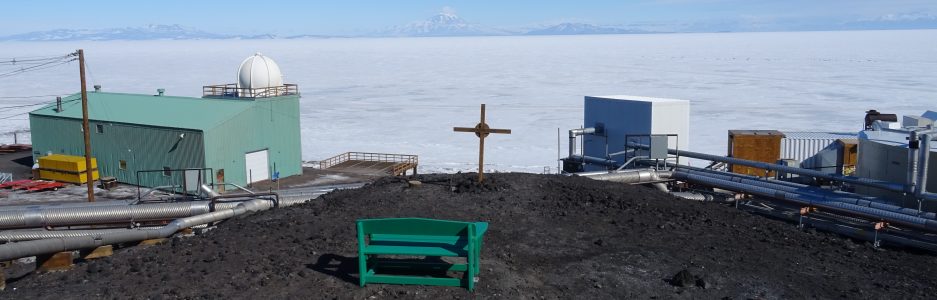
I received some really helpful feedback on my ‘Colonialism without Religion’ paper at the Antarctica and Colonialism workshop earlier this week. I’d like to thank everyone who participated in the conference, even though I don’t put names to comments here. A lot of Dipesh Chakrabarty’s early work related to the relationship between the secular and the sacred, so it would be interesting to revisit this, especially in relation to his subsequent turn towards climate and history. Within the South African Antarctic programme, religion can add another cause of difference with Black South Africans attending prayer meetings, and whites often being less keen. There is an interesting question of definition: when does spirituality become religion? What should I do with religion beyond Christianity? Is religion capable of creating a common language in a similar way to science? It’s really helpful to think about religion in relation to daily life in Antarctica. Religion offers one of the structures needed to keep people going. In the mid/late C.19th Matthew Fontaine Maury explicitly called on the nations of Christendom to explore the Antarctic, linking Antarctic exploration to the advance of nations. Cross placed at Kerguelen in 1923 by French colonial inspector, despite France being a secular state. How does religion frame the moral narratives of Antarctica? Does the attempt to draw commonality with the Antarctic experience end up reinforcing a sense of difference? Look at Ronit Y. Stahl’s Enlisting Faith: How the Military Chaplaincy Shaped Religion and State in Modern America (Harvard 2017). Does religion play a role in helping to justify the logic of humans over nature? Important to mention the Papal Bull as a foundation for Argentine and Chilean claims. Amundsen seems to have been a lot more secular than Scott, adding a religion dimension to the competition. There is an interesting relationship between religion and the sublime. Ask question about how religion drives actions in Antarctica. E.g. scientists from Brazil might understand the language of sacrifice while scientists from Germany might not (fish example). Two books that might be of interest here are Michel Serres: Branches: a philosophy of time, event, and advent (Bloomsbury 2020) and work by Hartmut Bohme on the sublime. Funerals and graves offer an important place for religion in Antarctic history. Perhaps a study of religion in Antarctica will reverse the Norwegian whaling saying ‘below 40 degrees there is no law, below 50 degrees there is no God’. Perhaps Antarctica offers an place where there can be an unmediated relationship between a human and their God?
Thoughts on Religion, Colonialism, and Antarctica

 Religion, Environment, History