Kathryn Yusoff, A Billion Black Anthropocenes of None (University of Minnesota Press: Minneapolis, 2018)
Although it’s probably not the interpretation that Kathryn Yusoff was expecting, A Billion Black Anthropocenes or None might be read as critical physical geography on a meta scale. The central argument seems to be that the Anthropocene is inextricably linked to deep structural racism and imperialism, most centrally to the history of trans-Atlantic slavery. The geology that gives us the Anthropocene is a White Geology that seeks to construct a geologic permanence out of racial inequality. Our current approach to the Anthropocene avoids confronting the fundamental issues of deep structural racism, and consequently offers little hope for getting through the coming storm (‘the diagnostic of the Anthropocene does not unleash any ethical crisis in liberal discourse about who is targeted by these material practices’ 902/1943). The Anthropocene looks to the future rather than to the past to avoid needing to feel a sense of guilt.
Yusoff’s writing style reminds me more of the environmental humanities than most of the geography I’ve read and is sometimes deliberately difficult to follow. ‘Drawing attention to a billion Black Anthropocenes, Yusoff writes, ‘is not a vehicle of visibility to see the dark underbelly of modernity with greater clarity, because it is already erased and caught in the process of erasure.’ I interpret this as meaning that there are no easy solutions, since the system itself is constructed to hide its true self (but I might be wrong). There is, however, a sense that a more positive way forward may be found by ‘forging a new language of geology… that attends to the racialization of matter’ (1632/1943). Poetry, poetics, and Denise Ferreira da Silva’s ‘poethics’ offer ways forward. The book also highlights the importance of Sylvia Wynter’s 900-page unpublished “Black Metamorphosis” in understanding where we are and moving forward (which Yusoff went to New York to read).
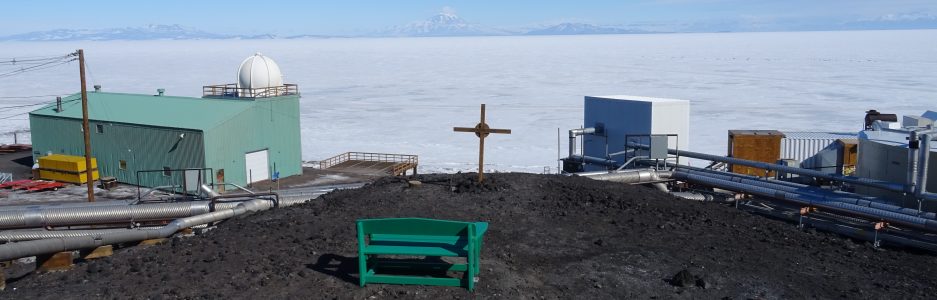
This could be a very helpful book for thinking about the history of the McMurdo Dry Valleys, and it is interesting to note that Yusoff’s early work focused on Antarctica (the idea that American genocide shows up in Antarctic ice-cores is fascinating). The idea of ‘White Geology’ and the politics of extraction might be particularly useful for thinking about the construction of the McMurdo Dry Valleys as an imperial landscape. The two reviews I read raised some interesting criticisms (e.g. ‘Yusoff does not decenter Eurocentric logics as much as she thinks she does’ in McKenzie Wark’s reivew). But this strikes me as an important book and well worth reading again.

 Religion, Environment, History